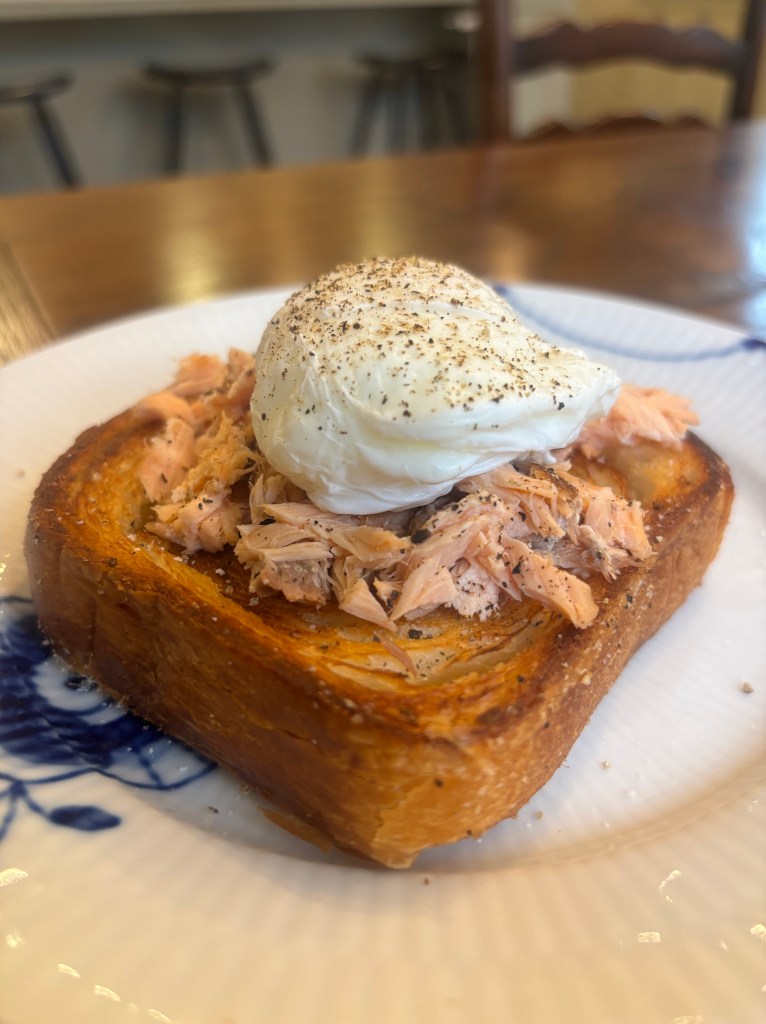
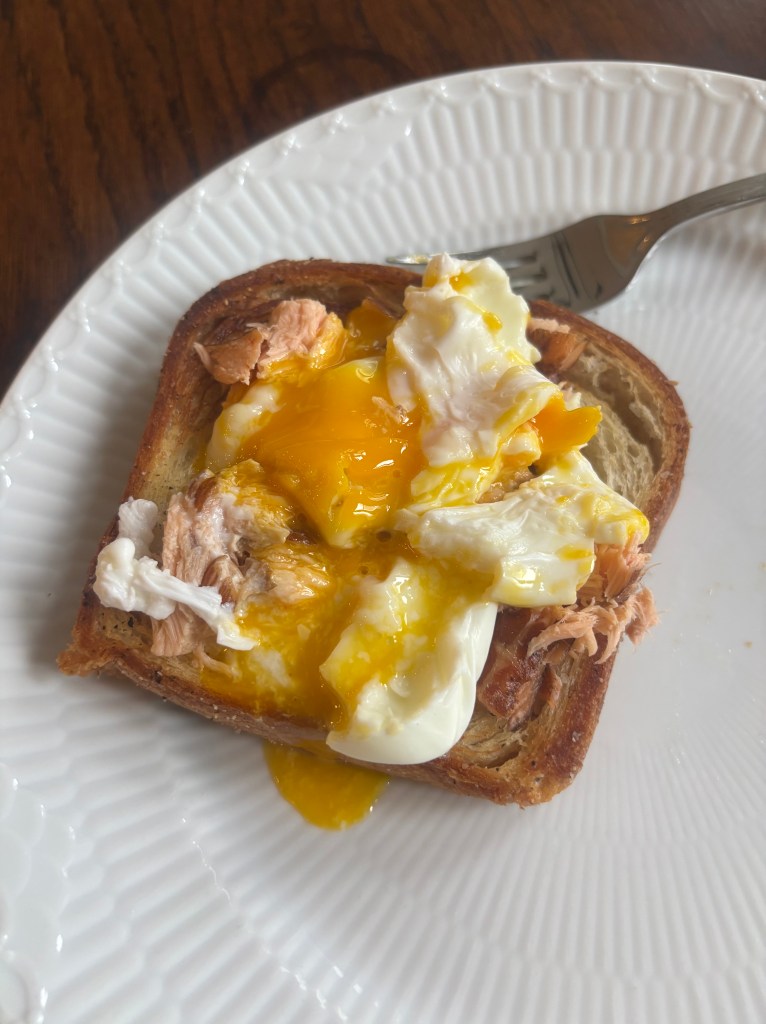
Eggs: Poached. On griddled croissant toast with hot smoke salmon. Song: "Birth of the Witch" by Master Wilburn Burchette from Guitar Grimoire apple musicspotify Poem: "An Inn for the Coven" by Gabrielle Calvocoressi (Originally published in You Are Here: Poetry in the Natural World, ed. Ada Límon, also published in The New Economy by Gabrielle Calvocoressi)
An Inn for the Coven
Witch hazel going wild along the walkway. And all the spots to sit and read our spell books. And all the ways to keep them out. Two black cats and a beaver who eats carrots all day. Every room an upper room even on the ground floor. And bee boxes in the way way back. And the sweet man who comes to keep them. All our loves are witches too. Or warlocks. All our children and all our children. Welcome. Water running in the brook. Clean enough to drink from our hands. And seven sources. And a deep well. All for us and all for those we bring over. Four swings in the branches. A library in every hollow. And birds. So many birds we stop trying to name them. We’ll just let them be with their own names. Maybe they’ll tell us. Porches. Tomatoes in the summer and pumpkins in the fall. And curry leaves and curry blossoms. Jasmine in the rooms at night. All loves protected. All of us playing cribbage on the lawn.
Note: Feeling witchy this post. On the one hand, you might say there's nothing witchy about these eggs. I say there is something witchy about all eggs. And poaching an egg feels like conjuring magic. Water at a low boil. A shot of vinegar. Stir to slow swirl and slide the egg into the vortex. Three minutes later, a little white satchel of witchcraft with gold inside. Alchemy.
I have a book, Albertus Magnus: Egyptian Secrets, which is a grimoire of spells and prayers and remedies. It is not, despite its name, a work of the 13th century alchemist, but likely that of an 18th-century Swabian (Germany) author who appropriates Magnus's name in order to lend the cures more authority. It is offered up without mockery; it is not some ironic jest at Magnus or a send-up of white witchery; rather, the spells, prayers, and homeopathy are offered up in all seriousness- I want to say genuinely, but it's hard to know if the purveyor of the snake oil knows it to be snake oil. In any event, either because people actually used it or because it has become a curio, the book-- to its credit, has been in publication, on and off, for a few hundred years. What is fake and real is all muddled up, in a very twenty-first century way. I thought I'd share a few choice egg remedies. Let me know how they work out.
To Destroy Worms: The cancer is healed by means of a plaster made of the yellow of the yellow of an egg, enzian, Easter herbs and centrifolium, all mixed up to a powder. This preparation apply often. When a Beast has the Erysipelas, and the Water looks as Red as Blood: Write the letters below upon a hen's egg, and give it the animal to eat: K a o r K S S O r E z o n r h a r K O C tz tz a h u r o x K a o tz a E a E S x i i x a r o t t t o x To Obtain Money: Take the eggs of a swallow, boil them, return them to the nest, and if the old swallow brings a root to the nest, take it, put it into your purse, and carry it in your pocket, and be happy. How to Beautify the Face: In the first place, take twelve or twenty-four fresh eggs, put them in a glazed pot, pour vinegar over the eggs, cover this well and keep it for eighteen days in a cellar; then pour the vinegar off, soak two loaves of wheaten bread in a quart of goat's milk, then take white wort, cut fine and mix together, put all in an alembic and distil to a water. When a Cow is Constipated: Take some bees'-wax, melt it and pour it into one pint of warm milk, stir it well, then beat four eggs, yolks and whites together, and give it to the cow all at once.
And here's an excerpt from Numero Group's webpage on Master Wilburn Burchette: California mail-order mystic Master Wilburn Burchette was first known from his ads, hidden in the back pages of Fate Magazine, Beyond Reality, and Gnostica News. On offer: Burchett’s seven-part, block-printed “Psychic Meditation Course,” designed to teach people how to listen to music. To go along with his lessons, Burchette sold a series of instrumental guitar and electronic records featuring ornate hand-drawn cover designs, complete with listening instructions from the Master himself. Since just his twelfth year, Burchette had been transfixed by the parapsychological, spending as much time reading books on Tibetan mysticism fundamentals as he did practicing guitar, the vibrations of which he used to create tonal pictures and patterns. After time spent teaching classical guitar, Master Wilburn Burchette released seven albums in the seven years spanning 1971 through 1977, before abruptly burning and discarding everything related to his musical explorations.
And on the poem. I admire Calvocoressi's "An Inn for the Coven" for lines like "All our loves / are witches." I also love the easy tone and voice that bats around the canned pop-culture spookery of witches. No cobwebs and pointy hats. No chin warts. Instead, with that swept aside, we get a kind of utopia, a rich natural abundance, a gentle harmony between people and the world. Maybe the point is that our reality now as we know it is bewitched, our souls trapped in little screens, the world paved in fire. So Calvocoressi's (de)witchery takes us forward or back to some other way. A portal. Master Wilburn Burchette would, I think, approve.
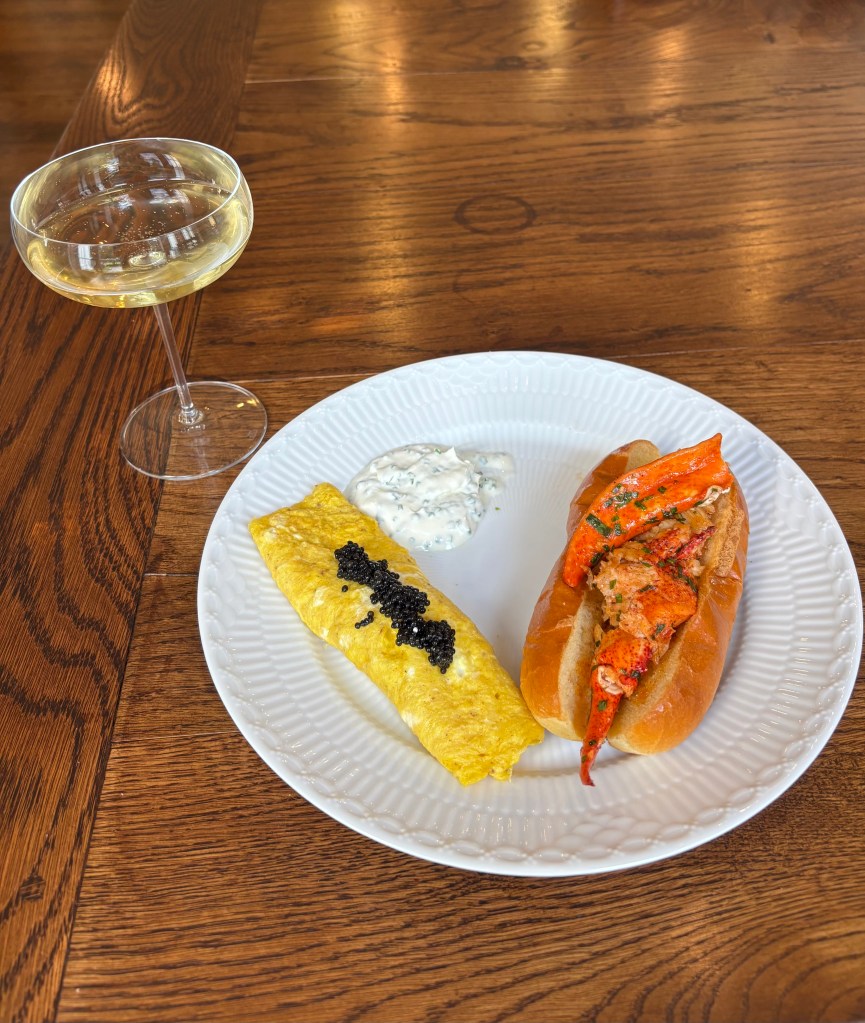
Eggs: Omelet with Caviar, Chive Crême Fraiche; Lobster Roll, Connecticut Style with Old Bay and Tarragon. Champagne.
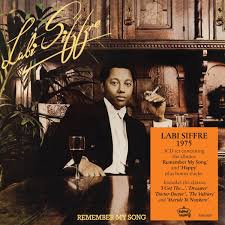
Song: "I Got the..." by Labi Siffre
        apple music
        spotify
Poem: "Toadstools" by Charles Wright

Toadstools

The toadstools are starting to come up,
                                                              circular and dry.
Nothing will touch them,
Gophers or chipmunks, wasps or swallows.
They glow in the twilight like rooted will-o’-the-wisps.
Nothing will touch them.
As though little roundabouts from the bunched unburiable,
Powers, dominions,
As though orphans rode herd in the short grass,
                                                       as though they had heard the call,
They will always be with us,
                                              transcenders of the world.
Someone will try to stick his beak into their otherworldly styrofoam.
Someone may try to taste a taste of forever.
For some it’s a refuge, for some a shady place to fall down.
Grief is a floating barge-boat,
                                               who knows where it’s going to moor?

Notes:
The eggs. I sent a picture of this meal to a friend with the caption: "Billionaire's Brunch or Death Row Last Meal." He replied, "A powerful, satirical critique of wealth inequality, institutional cruelty, and the commodification of human life. The two titles force the viewer to confront how society assigns value to the ultra wealthy versus the condemned." Exactly. And eats real good.

The song. I don't think Labi Siffre and I have that much in common. Except, based on this album cover,  how we roll in our respective chateaux any given Tuesday.
Thus, I think I could Labi would approve of this egg set up.
I’m going with divided plates this week. Bisected unities. Fish eggs on Chicken roe. Low omelet and high caviar. High lobster and low bun. Labi’s mashed two songs into one here, or built one song from two chambers. When a thing breaks in two, it begs the questions– which part serves the other? What came first, the little egg or the big egg? You’d think the big egg. But on the other hand, chickens came after dinosaurs. Who’s boss: caviar omelet or lobster roll? Which half of the Labi track is supreme? Were the parts designed from the whole or the whole from the parts?
Charles Wright’s poem also comes in two parts. We’re noodling on mushrooms, just staring at them and thinking, getting a little deep. And because death is a thing we are always aware of, that starts to darken the edges of our thought. And then: Grief is floating barge boat / who knows where it’s going to moor?
I think Wright is acutely aware of breaks. He takes the broken, offset line from Tang Dynasty poems and makes it his own thing– the “two step.” Here he’s got that signature two-step in four places, but the whole poem makes a two step from mushrooms into grief. I think you could take my banquet apart and enjoy the champagne, or the omelet with caviar, or the lobster roll, and be content. Likewise with Labi Siffre’s “I Got the…” You could take half and groove out. Yes, the part loses something by its unframing and it loses something else by the death of cross-currencies (the champagne not saucing the caviar, the bite of omelet not carrying into the lobster and tarragon), but they can still stand on their own. Not so with Wright’s “Toadstools.” Is this poem recognizable if it ends before the weird “floating barge boat” of grief? The words, sure, but there is something, an energy darkly tugging the poem (and its tugging that floating barge boat too) along, and if it stops before grief, I don’t think the poem earns its dark wisdom.
Eggs: Poached. Over Pulled Pork. On Griddled Croissant Toast.
Song: "Moonage Daydream" (Live 1973) by David Bowie (from Ziggy Stardust and the Spiders from Mars Soundtrack)
apple music
spotify
Poem: "Don't You Wonder, Sometimes?" by Tracy K. Smith (from Life on Mars)
Don't You Wonder Sometimes
1.

After dark, stars glisten like ice, and the distance they span
Hides something elemental. Not God, exactly. More like
Some thin-hipped glittering Bowie-being—a Starman
Or cosmic ace hovering, swaying, aching to make us see.
And what would we do, you and I, if we could know for sure

That someone was there squinting through the dust,
Saying nothing is lost, that everything lives on waiting only
To be wanted back badly enough? Would you go then,
Even for a few nights, into that other life where you
And that first she loved, blind to the future once, and happy?

Would I put on my coat and return to the kitchen where my
Mother and father sit waiting, dinner keeping warm on the stove?
Bowie will never die. Nothing will come for him in his sleep
Or charging through his veins. And he’ll never grow old,
Just like the woman you lost, who will always be dark-haired

And flush-faced, running toward an electronic screen
That clocks the minutes, the miles left to go. Just like the life
In which I’m forever a child looking out my window at the night sky
Thinking one day I’ll touch the world with bare hands
Even if it burns.


          2.

He leaves no tracks. Slips past, quick as a cat. That’s Bowie
For you: the Pope of Pop, coy as Christ. Like a play
Within a play, he’s trademarked twice. The hours

Plink past like water from a window A/C. We sweat it out,
Teach ourselves to wait. Silently, lazily, collapse happens.
But not for Bowie. He cocks his head, grins that wicked grin.

Time never stops, but does it end? And how many lives
Before take-off, before we find ourselves
Beyond ourselves, all glam-glow, all twinkle and gold?

The future isn’t what it used to be. Even Bowie thirsts
For something good and cold. Jets blink across the sky
Like migratory souls.


          3.

Bowie is among us. Right here
In New York City. In a baseball cap
And expensive jeans. Ducking into
A deli. Flashing all those teeth
At the doorman on his way back up.
Or he’s hailing a taxi on Lafayette
As the sky clouds over at dusk.
He’s in no rush. Doesn’t feel
The way you’d think he feels.
Doesn’t strut or gloat. Tells jokes.

I’ve lived here all these years
And never seen him. Like not knowing
A comet from a shooting star.
But I’ll bet he burns bright,
Dragging a tail of white-hot matter
The way some of us track tissue
Back from the toilet stall. He’s got
The whole world under his foot,
And we are small alongside,
Though there are occasions

When a man his size can meet
Your eyes for just a blip of time
And send a thought like SHINE
SHINE SHINE SHINE SHINE
Straight to your mind. Bowie,
I want to believe you. Want to feel
Your will like the wind before rain.
The kind everything simply obeys,
Swept up in that hypnotic dance
As if something with the power to do so
Had looked its way and said:
                                                     Go ahead.
Notes:
On the poach: The thrill of poaching an egg: sliding the egg into a simmering vortex. It feels acrobatic, risky, without a net. It's not hard to do, but it feels like doing it wrong could be disastrous-- the little sun of egg unbound from its gravitational nest, stretched and stripped into ribbons, flung to the far reaches of the pot. But when it holds, which really is always when done with a little care, it is a lovely thing. A little purse of egg. Open it up and sauce out the sun.

On the song: I'm an alligator. The future was way cooler in the 60s than it is in 2020s. They had all that silvery moon stuff. Hover cars, gizmos, and funny robots. And the future got even cooler--weirder, wilder--in the 70s. Bowie, alien ambassador, lands with Martian swagger, speaking English as a second language. We see Ziggy and the Spiders on stage and wonder whether its them or us who's strange. I listen to Kraftwerk, and I want to hit the dance floor with robots with gangly arms and creaky hips. Another, darker favorite from the 70s is Gary Numan, who obsesses (rather prophetically) about creepy cyborgs, about a future of bots and alienation. Sort of the musical analog to Blade Runner.

On the poem: Smith writes: "The future isn't what it used to be. Even Bowie thirsts / For something good and cold. Jets blink across the sky / like migratory souls." Those lines slay me. The sadness of those jets - beautiful and hopeful in their blinking, but ultimately bound to this earth. The migratory souls must return. Smith's scene reminds me of Mark Fisher on lost futures. Fisher argues that 21st-century culture is marked by anachronism and inertia, a "stasis [that] has been buried, interred behind a superficial frenzy of 'newness', of perpetual movement. The 'jumbling up of time', the montaging of earlier eras, has ceased to be worthy of comment; it is so prevalent that it is no longer noticed." (6 Ghosts of My Life). Fisher here is observing how culture has stopped imagining a future, how it is more interested in retreading old films, old music, old culture-- anything retro-- than in leaning forward. Elsewhere, he puts it concisely: to be in the 21st century, is to have 20th century culture brought to us by 21st century technology.

To make his case, Fisher invites us to contemplate when Kraftwerk came on the scene-- imagine how shockingly futuristic Kraftwerk sounded to listeners in 1970, how strangely futuristic. What, today, sounds like such a great leap forward into the unknown? Rather, Fisher points out that music (and other cultural artifacts) of the 21st century are really difficult to place in time. For example, he points to the Arctic Monkeys, whose song "I Bet You Look Good on the Dancefloor" could be from 1980, 1990, 2000, 2010.... it is timeless only in the static perjorative sense. Why has this happened? Fisher essentially argues that we have killed off all of the good futures we once imagined. Once, we dreamed about the future as positive progress, a place where we transcended what ails, a place bettered by dignity, justice, security, freedom. Instead, Fisher argues, we have given up our visions of more utopian futures, and have surrendered to the realism that there is no alternative to the advanced capitalism that has come to dominate.  The world, ever more efficiently commercialized, is not so much flattening out as it is hollowing out.

Fisher is writing (2013) before the rise of AI, but I think AI slop would be another case to validate what he is observing. As would the enshittification of the internet. More gray tentacles of capitalism choking us into cultural stasis, the sense of no-exit making us recoil from the future into a nostalgia for the past.  Our visions of living on other planets? Who wants to live on Mars when it is run by Musk? The promise of the internet? There are now more bots online than people, as it has (d)evolved into a commercial surveillance and persuasion machine. Our attention--which Simone Weil would argue that is, in its highest degree the same as a prayer, has now become a red hot economy. And can anyone now, still believe that life with AI (when AI is controlled by corporations) is going to be better, happier, more fulfilling than life without it? The enshittification of the market keeps spreading. Dollars and digits animate/decay all matter. Satellites in the sky. Betting markets on military operations. Where are the funky robots? The intergalactic rock stars? Come back, Bowie, save us.
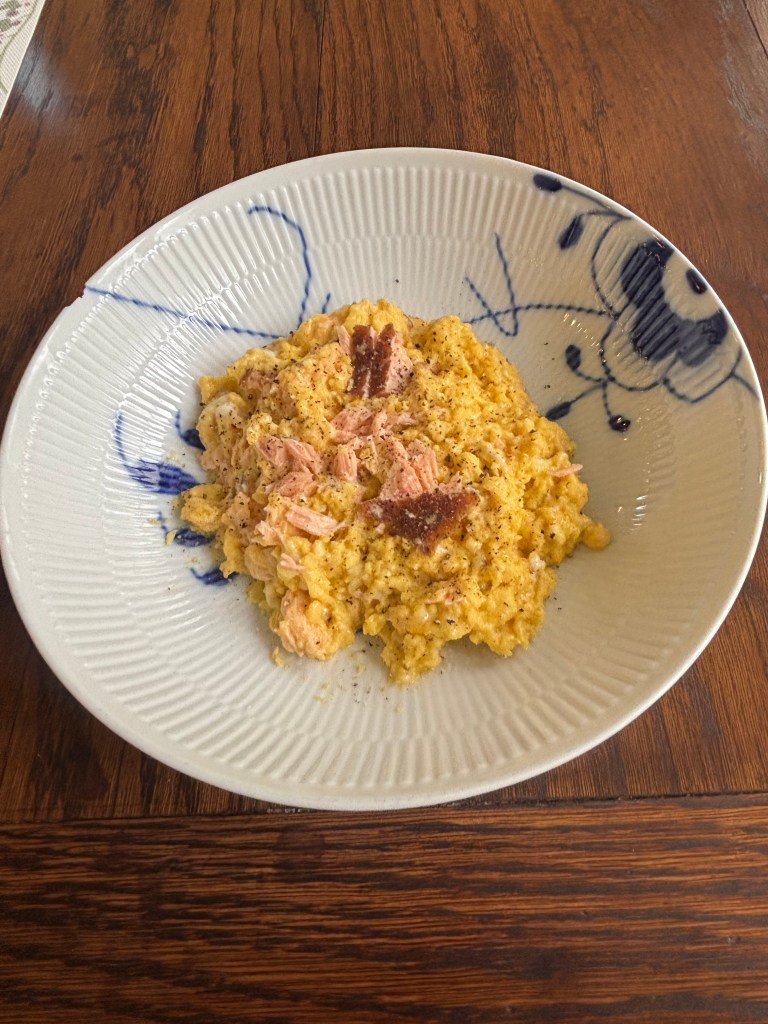
Eggs:Slow Scramble, French Style, with Hot-Smoked Salmon.
Music:"The Creator Has a Master Plan" by Pharaoh Sanders apple music spotify
Poem: "Letter of Testimony" by Octavio Paz (translated by Eliot Weinberger, The Poems of Octavio Paz). It's a lonnnnnnnnng poem. Best enjoyed somewhere you can settle with a strong cup of something. Or you can scroll past if you want to skip to the notes.
Letter of Testimony Cantata 1. Between night and day there is an uncertain territory. It is neither light nor shadow: it is time. The hour, the precarious pause, the darkening page, the page where I write, slowly, these words. The afternoon is an ember burning itself out. The day turns, dropping its leaves. A dark river files at the edges of things. Tranquil, persistent, it drags them along, I don't know where. Reality drifts off. I write: I talk to myself -- I talk to you.
I wanted to talk to you as the air and this small tree talk to each other, nearly erased by the shadows; like running water; a sleepwalking solilquoy; like a still puddle, reflector of instantaneous simulacra; like fire: with tongues of flame, a dance of sparks, tales of smoke. To talk to you with visible and tangible words, words with weight, flavor and smell, like things. While I speak, things imperceptibly shake loose from themselves, and escape toward other forms, other names. They leave me these words: with them I talk to you.
Words are bridges. And they are traps, jails, wells. I talk to you; you don't hear me. I don't talk with you: I talk with a word. That word is you, that word carries you from yourself to yourself. You, I, and fate created it. The woman that you are is the woman I talk to: these words are your mirror, you are yourself and the echo of your name. I, too, talking to you, turn into a whisper, air and words, a puff, a ghost that rises from these letters.
Words are bridges: the shadow of the hills of Meknès over a field of static sunflowers is a violet bay. It is three in the afternoon, you are nine years old and asleep in the cool arms of a pale mimosa. In love with geometry a hawk draws a circle. The soft copper of the mountains trembles on the horizon. The white cubes of a village in the dizzying cliffs. A column of smoke rises from the plain and slow scatters, air into the air, like the song of the muezzin that drills through the silence, ascends and flowers in another silence. Motionless sun, the enormous space of spread wings, over the flat stretches of reflections thirst raises transparent minarets. You are neither asleep nor awake: you float in a time without hours. A breeze barely stirs the distant lands of mint and fountains. Let yourself be carried by these words toward yourself.
2. Words are inexact and say inexact things. But saying this or that, they say us. Love is an equivocal word, like all words. It is not a word, said the Founder: it is a vision, base and crown of the ladder of contemplation --and the Florentine: it is an accident --and the other: it is no virtue but it is born of that which is perfection --and the others: a fever, an aching, a struggle, a fury, a stupor, a fancy. Desire invents it, mortifications and deprivations give it life, jealousy spurs it on, custom kills it. A gift, a sentence. Rage, holiness. It is a knot: life and death. A wound that is the rose of resurrection. It is a word: saying it, we say ourselves.
Love begins in the body --where does it end? If it is a ghost, it is made flesh in a body: if if is a body, if vanishes at a touch. Fatal mirror: the desired image disappears, you drown in your own reflections. A banquet for shades.
Apparition: the moment has eyes and a body, it watches me. In the end life has a face and a name. To love: to create a body from a soul, to create a soul from a body, to create a you from a presence. To love: to open the forbidden door, the passageway that takes us to the other side of time. The moment: the opposite of death, our fragile eternity.
To love is to lose oneself in time, to be a mirror among mirrors. It is no idolatry: to deify a creature and to call eternal that which is worldly. All of the forms of flesh are daughters of time, travesties. Time is evil, the moment is the Fall; to love is to hurl down: interminably falling, the couples we is our abyss. The caress: hieroglyph of destruction. Lust: the mask of death.
To love: a permutation, barely an instant in the history of primogenial cells and their innumerable divisions. Axis of the rotation of the generations.
Invention, transfiguration: the girl turns into a fountain, her hair becomes a constellation, a woman asleep, an island. Blood: music in the branches of the veins, touch: light in the night of the bodies.
Transgression of nature's fatality, hinge that links freedom and fate, question engraved on the forehead of desire: accident or predestination?
Memory, a scar: --from where were we ripped out? a scar, memory, the thirst for presence, an attachment to the lost half. The One is the prisoner of itself, it is, it only is, it has no memory, it has no scars: to love is two, always two, the embrace and the struggle, two is the longing to be one, and be the other, male or female, two knows no rest, it is never complete, it whirls around its own shadow, searching for what we lost at birth, the scar opens: fountains of visions, two: arch over the void, bridge of vertigoes, two: mirror of mutations.
3. Love, timeless island, island surrounded by time, clarity besieged by night. To fall is to return, to fall is to rise.
To live is to have eyes in one's fingertips, to touch the knot tied by stillness and motion. The art of love --is it the art of dying? To love is to die and live again and die again: it is liveliness. I love you because I am as mortal as you are. Pleasure wounds, the wound flowers. In the garden of caresses I clipped the flower of blood to adorn your hair. The flower became a word. The word burns in my memory.
Love: reconciliation with the Great All and with the others, the small endless all. To return to the day of origin. To the day that is today.
The afternoon founders. Street lamps and headlights drill through the night. I write: I talk to you: I talk to me. With words of water, fire, air, and earth, we invent the garden of glances. Miranda and Ferdinand gaze forever into each other's eyes until they turn to stone. A way of dying like others. High above the constellations always write the same word; we, here below, write our mortal names. The couple is a couple because it has no Eden. We are exiles from the Garden, we are condemned to invent it, to nurture our delirious flowers, living jewels we clip to adorn a throat. We are condemned to leave the Garden behind: before us is the world.
CODA Perhaps to love is to learn to walk through this world. To learn to be silent like the oak and the linden of the fable. To learn to see. Your glance scatters seeds. It planted a tree. I talk because you shake its leaves.
Notes: I was aiming for a long slow scramble of these eggs, intending to execute the classic French mode for a scramble. To do that, I should have used a double boiler, but I went for low heat on the burner, and they came together more quickly than I had planned. Silky, but not as crême de luxe as I wanted. To go with the slow cook, I put on Pharaoh Sanders half-hour "The Creator Has A Master Plan" which ended up being long enough to both cook and eat eggs by. And in keeping with the theme of long-form works, I've posted one of Octavio Paz's long poems, "Letter of Testimony."
In the song, the mantra boxes itself in: The creator has a working plan / peace and happiness for every man / The creator has a master plan / peace and happiness for every man / The creator has but one demand / peace and happiness through all the land. Then it dissolves into a bunch of "yeahs." Then it further unravels into some yodeling ululations, and then the lyrics stop and surrender to the music. I'm interested by a few things. First, the way the rather inane mantra picks up resonance by repetition. If there were a bunch of verses and "peace and happiness" bit were the chorus, I'd be disappointed. But here, it's like there's nothing else to say, even though these words don't suffice. They hit a wall, they hit their limit, and then it's just human voice, and then that stops and it's music. And the music too moves from melody and groove to something wilder and rawer. It makes me think about Deleuze & Guattari -- there is the body (with its rules and structures) and then there is the body without the organs that govern it. There is the unfolding of what has been ruled into what it might be if it were born into and lived in a world without rules. Here, Sanders & co take the organs out of the body (and eventually put them back in). And I think the music accomplishes what the words cannot. Sanders is aiming for the cosmic, the mystical, the transcendent, and he trusts the music more than the words to take us there.
I picked this Paz poem not just because I love Paz, but also because I think his poem is exploring similar territory to Sanders. The poem keeps hitting the dead end of words: "I talk to you." "I write." I feel the failure of words to do what the speaker wants them to do. The words don't bridge, they don't open, they don't carry, they don't pierce or translate or sing. At least not enough. As in the Sanders song, they hit the wall and realize their own impotence. But Paz, unlike Sanders, doesn't give up and turn to music, he keeps writing more words. And the words keep turning like a kaleidoscope through images and reconfigurations of the same images. Along the way, I think, like Sanders' music freakout, Paz's words start to get there, start to transcend their failure.
Sanders is audacious in writing a half hour song opening out of a cosmic bumper sticker (and succeeds in getting me to actually contemplate his bumper sticker). Paz is audacious in a writing a series of "To love is to...." That seems like a syntactical construction fated to end in cliché, an anaphora any poetry instructor would put on the merde list of "never do this." But Paz does. And it works for me.
I found the stairs somewhat more difficult than I had expected and so I sat down, so to speak, in the middle of the journey. Because there was a large window opposite the railing, I was able to entertain myself with the little dramas and comedies of the street outside, though no one I knew passed by, no one, certainly, who could have assisted me. Nor were the stairs themselves in use, as far as I could see. You must get up, my lad, I told myself. Since this seemed suddenly impossible, I did the next best thing: I prepared to sleep, my head and arms on the stair above, my body crouched below. Sometime after this, a little girl appeared at the top of the staircase, holding the hand of an elderly woman. Grandmother, cried the little girl, there is a dead man on the staircase! We must let him sleep, said the grandmother. We must walk quietly by. He is at that point in life at which neither returning to the beginning nor advancing to the end seems bearable; therefore, he has decided to stop, here, in the midst of things, though this makes him an obstacle to others, such as ourselves. But we must not give up hope; in my own life, she continued, there was such a time, though that was long ago. And here, she let her granddaughter walk in front of her so they could pass me without disturbing me.
I would have liked to hear the whole of her story, since she seemed, as she passed by, a vigorous woman, ready to take pleasure in life, and at the same time forthright, without illusions. But soon their voices faded into whispers, or they were far away. Will we see him when we return, the child murmured. He will be long gone by then, said her grandmother, he will have finished climbing up or down, as the case may be. Then I will say goodbye now, said the little girl. And she knelt below me, chanting a prayer I recognized as the Hebrew prayer for the dead. Sir, she whispered, my grandmother tells me you are not dead, but I thought perhaps this would soothe you in your terrors, and I will not be here to sing it at the right time.
When you hear this again, she said, perhaps the words will be less intimidating, if you remember how you first heard them, in the voice of a little girl.
from Faithful and Virtuous Night
Notes: "He is at that point in life at which neither returning to the beginning nor advancing to the end seems bearable; therefore, he has decided to stop, here, in the midst of things, though this makes him an obstacle to others, such as ourselves." I love how the narration of ordinary takes on the resonance of allegory. It's in both the tone (the register shifts in a way that reminds me of Barthelme's "The School") and in the double focus: Glück both stays in the scene she has created and pans out toward something like universal wisdom. It takes gall to do what you're not supposed to do in poetry-- wax discursive on the Truth. But I think Glück pulls it off because the scene is weird enough to lock us into the moment, and because the wisdom of her seer-grandmother is equal parts true and mystical, wise as it is to the existential paralysis and particular species of depression that den in middle age (or whatever age we assign to what is in between very young and very old). What does Glück put her finger on? Through the voice of the grandmother, she knows how a person gets stuck on their climb. How he and everyone else gets there. Scared enough to stop on stairs. Or hide in crowds. Or file complaints. Or get swole and swear they'll live forever.
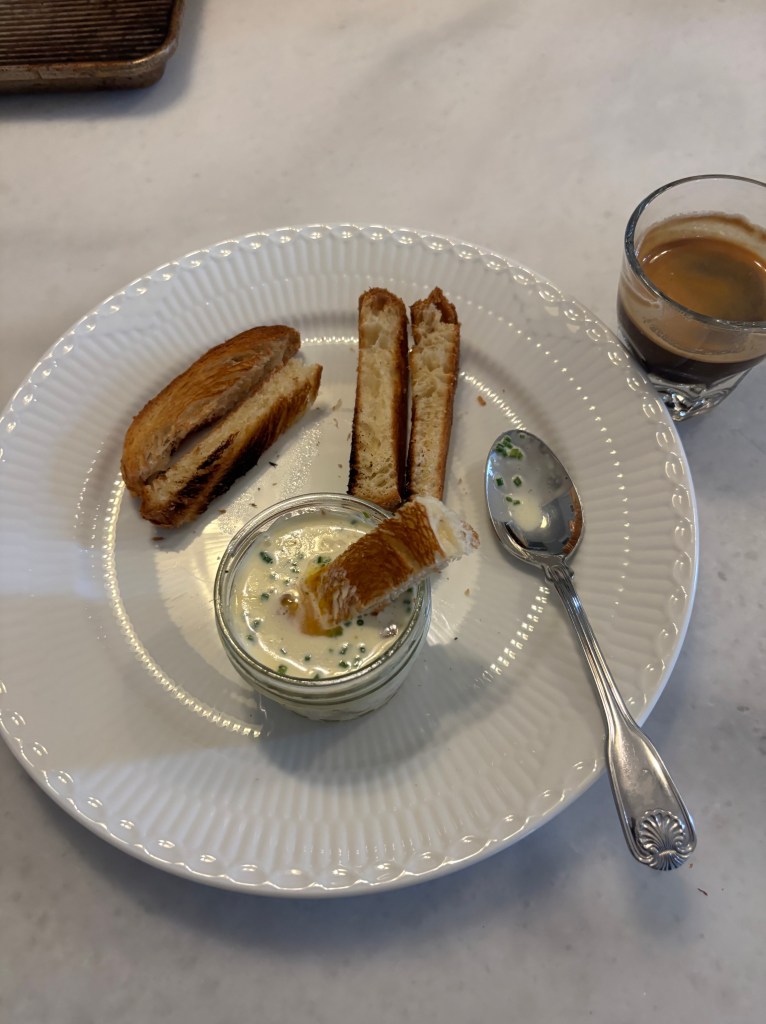
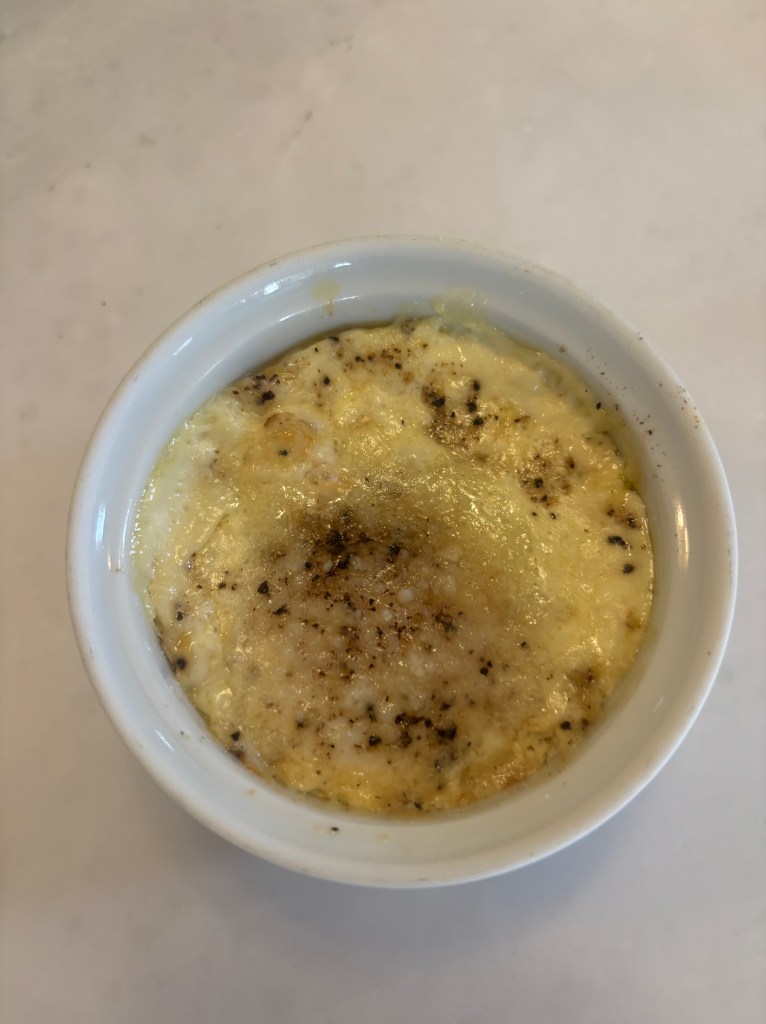
These eggs split the distance between workmanlike and luxe. Cook em in jar. An egg sandwiched in a little cream. Some fancy ingredients or not. Pull em from the bake before they get too defined...
The music - Glück and these eggs. Exhibits A and B as to how simple is a difficult thing. And for a creator, a maker, to present "simple" as a deliverable takes brass. Cream and eggs-- it all rides on texture, nowhere to hide. Getting the whites just to hold, the yolk molten. See how Glück rings wisdom into a what seems merely an inconsequential slab of a tale from the odd. Hell of a trick to pull that off. As Lucas sings, "It's so easy when you know what you're doing." I'm a fan of slow deliveries-- Lucas, Leonard Cohen, Bill Callahan-- where the lyrics are out in front, dangling, nowhere to hide. Where words and lines unfold slowly and are left naked in the light. And I love how, on this album, Lucas literally doubles down, double tracking himself singing with himself. It makes me feel both ways. Comforted. How lovely to hear the self sing with the self. And lonely. Because who are we singing for?
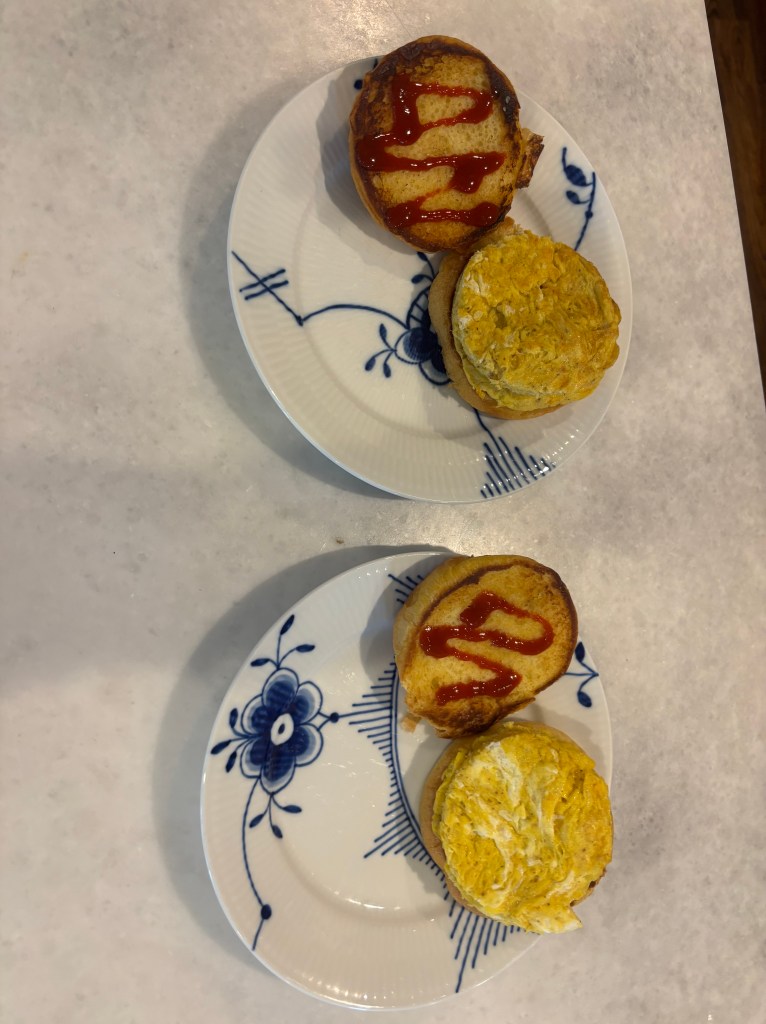
Eggs: Father and Son Egg & Cheese Sandies, Griddled Brioche, Yellow Bird Agave Sriracha.
Song: “I Had Too Much to Dream Last Night” by The Space Lady apple music spotify
Poem: “At the Zoo” by Alfred Starr Hamilton At the Zoo
On the back of an invoice I wrote my name in large Capitalist June Blue Letters
And because money was involved And so was my name ever in jeopardy
On the back of the same invoice I rewrote my name in large Capitalist June Blue Letters
And in Leopardy and in Jeopardy I resolved, dissolved upon a radical eradicator
Inking in, dissolving upon Jeopardizing my own name in large Capitalist June Blue Letters
from A Dark Dreambox of Another Kind: The Poems of Alfred Starr Hamilton (The Song Cave)
Notes: The Space Lady wears a winged helmet. A little red nubbin of a bulb on top lights up. She has lived in a cave. In an early formative experience, she listened to her sister play Schubert on the piano while high for the first time. She saw music dancing around the room, waves of clefts, the colors of notes. She realized she was looking into another dimension– one of the ones always there, and she felt, if only our senses were not so limited, our multi-dimensional existence would be evident to everyone. It is both clear and unclear how this informs her art.
Alfred Starr Hamilton, the bard of Montclair, New Jersey. Born, raised, lived, died in Montclair. Every week during the 1960s, Hamilton would send Cornell’s lit mag (Epoch) about 45 poems. 45 poems. Every week. Boxes of his work cluttered the offices. Thousands of his poems have been lost. Hamilton was not a careful preserver, curator, or even editor of his stuff. Here’s Geof Hewitt quoted in the New York Times: “Alfred Starr Hamilton wrote both breathtaking and inane poems without seeming to know the difference, and I think the editors who published his work, myself included, were sometimes similarly confused.” And in addition to writing a Dickinsonian quantity of poems, Hamilton also wrote (unhinged? poetic? prank?) letters to the local police. Here’s a plum: “Dear Police; Is anything of this kind surreptitious?” reads one letter dated Jan. 10, 1983. “I don’t know. Make sure everything is alright. Send this to the immune officer. I am immune. Alfred Starr Hamilton.” (NYT)
And one last quote from the NYT piece about Hamilton, because these words seem relevant to the Space Lady as well: “Crazy [wo]man? Erratic genius? Authentic, untutored voice? Inkblot misinterpreted as art? All of the above? Cynics and romantics can find something to like in [the Space Lady’s] Hamilton’s life, though it’s unlikely to be the same thing.”
The Space Lady is cult-cool again after retiring from music after her cover of “I Had Too Much to Dream Last Night” got picked up by an influential compilation of outsider art called Songs in the Key of Z. Hamilton too was culturally resurrected by those looking for outsiders– Weird New Jersey, purveyors of the Jersey strange. While I think outsider art can be appreciated to some extent its own moment — the Space Lady and Hamilton had small bands of fans in their day– it seems like, with age, weird art, anti-art grows in appeal. Maybe, with retrospect, as the mainstream (pop or art) culture of a particular era clarifies, it become easier to see outsider art as not just strange, but creative in how it rejects the mainstream. Or maybe it’s just that time better protects us from the freaks. I don’t know. Send this to the immune officer. I am immune.
And what of the eggs? I make these egg sandies at least once a week for my son and me. A mainstream dish in our house. An egg sandie is not exactly outsider art by any measure. But maybe not every egg dish need be breathtaking or sublime. And maybe like Hamilton with his thousands of poems (and letters to the police), or the scraps of talents and visions that is the assemblage we know as The Space Lady, it is the sum total itself that is the work of art. I’ve cooked and/or eaten eggs every day now for two weeks. If I can keep this up for another quarter century, maybe it is the practice (not the substance) that elevates the long playing eggpoem to art.
Poem: from The Book of Questions by Pablo Neruda (I-II) I. Why don’t the immense airplanes fly around with their children?
Which yellow bird fills its nest with lemons?
Why don’t they train helicopters to suck honey from the sunlight?
Where did the full moon leave its sack of flour tonight?
II. Tell me, is the rose naked or is that her only dress?
Why do trees conceal the splendor of their roots?
Who hears the regrets of the thieving automobile?
Is there anything in the world sadder than a train standing in the rain?
Translated by William O’Daly. Copper Canyon Press. 1974, 2001.
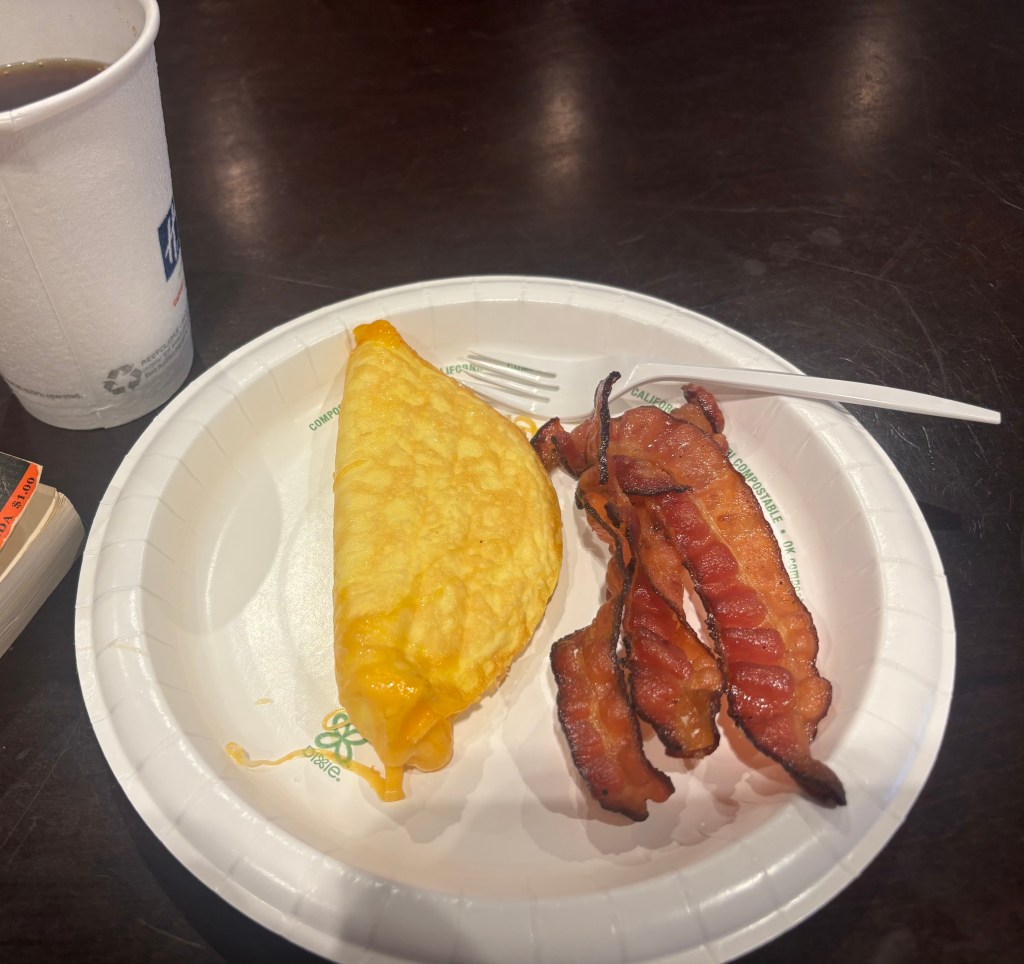
Notes: The fine folks at Holiday Inn Express run a far finer establishment than the Travelodges John Darnielle sings about in “Palmcorder Yajna.” And I feel like it’s bad form to knock a complimentary breakfast. With those disclaimers out of the way, I will say these eggs were a little weird. I couldn’t figure out if a chef, like actually, made these, or whether a machine did. Sort of the way a possibility of AI now destabilizes the actuality of anything too beautiful. My guess is these are a chef’s work. If so, stars for precision. But there was also an automatic pancake machine on hand, so that complicates the analysis. And a surprising uniformity in size and fold among the few dozen of these beauties warming in the chafing dish. What are the morals here, the touchstones as to how to live, how to stay awake? Maybe we are closest to the strangeness of the real where it dissolves, where it is faked or approximated by formula, at places like the edge of sleep in the slurry between reality and dream or the mind of a tweaker like the world of “Palmcorder Yajna.” And/or maybe the beauty is, as in Neruda’s constraint, just asking the questions.
Poems: “Archaic Torso of Apollo” by Rainer Maria Rilke “Lying in a Hammock on William Duffy’s Farm in Pine Island, Minnesota:
Archaic Torso of Apollo
We cannot know his legendary head with eyes like ripening fruit. And yet his torso is still suffused with brilliance from inside, like a lamp, in which his gaze, now turned to low,
gleams in all its power. Otherwise the curved breast could not dazzle you so, nor could a smile run through the placid hips and thighs to that dark center where procreation flared.
Otherwise this stone would seem defaced beneath the translucent cascade of the shoulders and would not glisten like a wild beast’s fur:
would not, from all the borders of itself, burst like a star: for here there is no place that does not see you. You must change your life.
translated by Stephen Mitchell, Ahead of All Parting: Selected Poetry and Prose ofRainer Maria Rilke
Lying in a Hammock on William Duffy’s Farm in Pine Island, Minnesota
Over my head, I see the bronze butterfly, Asleep on the black trunk, Blowing like a leaf in green shadow. Down the ravine behind the empty house, The cowbells follow one another Into the distances of the afternoon. To my right, In a field of sunlight between two pines, The droppings of last year’s horses Blaze up into golden stones. I lean back, as the evening darkens and comes on. A chicken hawk floats over, looking for home. I have wasted my life.
from Above the River: The Complete Poems of James Wright
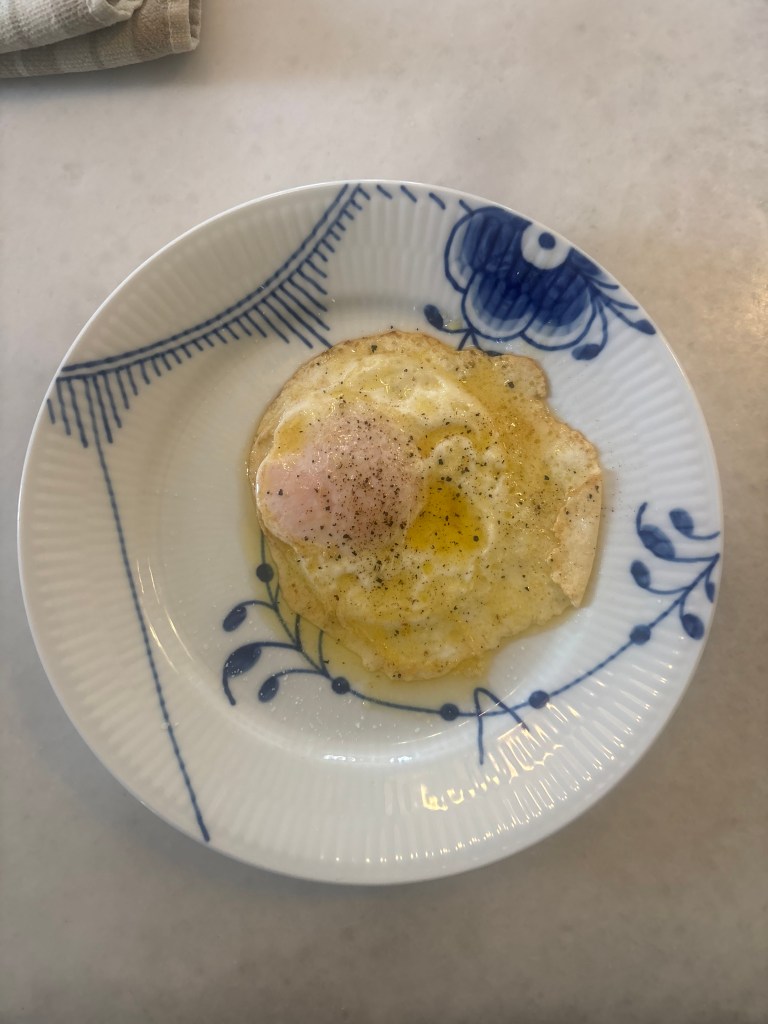
Notes: Like Apollo’s torso, a egg over easy is suffused with brilliance from inside.
Like the persona in Bobby Charles’ “Street People,” this is an egg that you want to hang out with, a egg with whom to share a few High Lifes at the neighborhood dive. They’ve got stories for days. They’ve got some thoughts. They’re in no hurry. Are you?
Like lying in a hammock on a farm in Minnesota, enjoying some excellent over-easies can distill the present with such clarity that you might reconsider whether you’re living your life the way you ought. One thing’s pretty clear: you should eat more eggs.
Song: “In Walked Bud” by Thelonious Monk (from Genius of Modern Music, Vol 1.) apple musicspotify
Poem: “Piano Lesson” by Richard Siken (from I Do Know Some Things)
Piano Lesson
When I was ten, I had an imaginary friend. He lived on pork and beans and played the viola. People would look at us and hear sad music, turn away. That’s pretty much how it was, what it was like, for most of 1977. A viola is slightly larger than a violin. It makes a deeper sound. The cello and the double bass: larger and deeper still. All, like, Pinocchio, have hollow wooden bodies, thought Pinocchio has more strings and is hollow only metaphorically. Guitars have strings. Harps also. If a harp lay down and fell asleep and you bludgeoned its dreams with felted hammers then you would have a piano. If you were wearing a tuxedo, you would have a grand piano. If you knocked a clock to the floor and left it there, on its back, staring at the ceiling, spinning slowly to its own sad music, then you would have a record player. Or a carousel, if you had horses, or luggage. A table turns into a barricade, a vase into a broken vase. The lazy Susan becomes the place where the lazy Susan used to be. Pinocchio wants to be a real boy. The real boy wants to be a robot. The dream of becoming. By 1699, although there were no pianos, some composers were already anticipating their arrival. Sheet music from the time shows notes too high or low to play on the harpsichord. By 1837, with some refinement of the pedals, a player could sustain the notes even after their hands had moved away. By the time I was eleven I sopped being sad and started to be afraid.
Notes: If I took piano lessons, I’d ask my teacher to help me learn “In Walked Bud.” I remember hearing this song for the first time working at garden nursery center in high school. A college kid I worked with had it on tape and we listened to it as he drove a truck full of mum cuttings. Jazz was not a thing I knew. Thelonious was an excellent place to start.
In one of Siken’s other prose poems in I Do Know Some Things, he describes his sensibility as “metamodernist,” a term I had to look up. I’m on board. Like everyone else I know who did college in the 90s, I’ve run dry on postmodernism. Then there are those unhelpful, unlovely terms for where the world went next: post-truth, post-postmodernism, both of which are about as appealing as nihilism. Here’s Siken, in an interview Mandana Chaffa in the Chicago Review of Books explaining how he intends the term:
“[metamodernism is] characterized by an oscillation between seemingly opposing forces like enthusiasm and irony, sincerity and self-awareness. It’s not so much a tactic as a paradigm. Meaning can be both staged and honest. In some sense, meaning is staged on a foundational level. All language is staged; all sentences are speech acts. Similarly, all actions—even walking—are choreographed to some extent. Practice and intentionality are needed. . . the authentic self and the constructed self can exist simultaneously. What’s the distinction between expressing and performing? What’s the distinction between hope and prayer?”
Wikipedia has a nifty little swinging pendulum that captures how metamodernism continually oscillates “from the sincere seriousness of modernism to the ironic playfulness of postmodernism.” Earnest/Hopeful/Sincere —–> Playful/Cynical/Ironic.
This strikes me as right for art in 2026. On guard against naïveté, but burnt out on cynicism. By turns playful and serious. By turns, earnest and ironic.
Song: “Depreston” by Courtney Barnett (from Sometimes I Sit and Think, and Sometimes I Just Sit) apple musicspotify
Poem: “Lucky Dragon” by Mary Ruefle (from The Book)
Lucky Dragon
God walked into the Lucky Dragon and, in a tired, half-dead voice, ordered a Shanghai spring roll, wonton soup, steamed dumplings, chicken fried rice, egg foo young, moo shu pork, sweet and sour shrimp, and General Tso’s chicken. He loved everything, he ate ev- erything, but the twelve fortune cookies that came after he did not care for, so he folded them carefully into the dough of a dozen unborn children, hoping for the best. While the staff remained watching from the kitchen door, God walked out slowly, absolutely full, unable to fly.
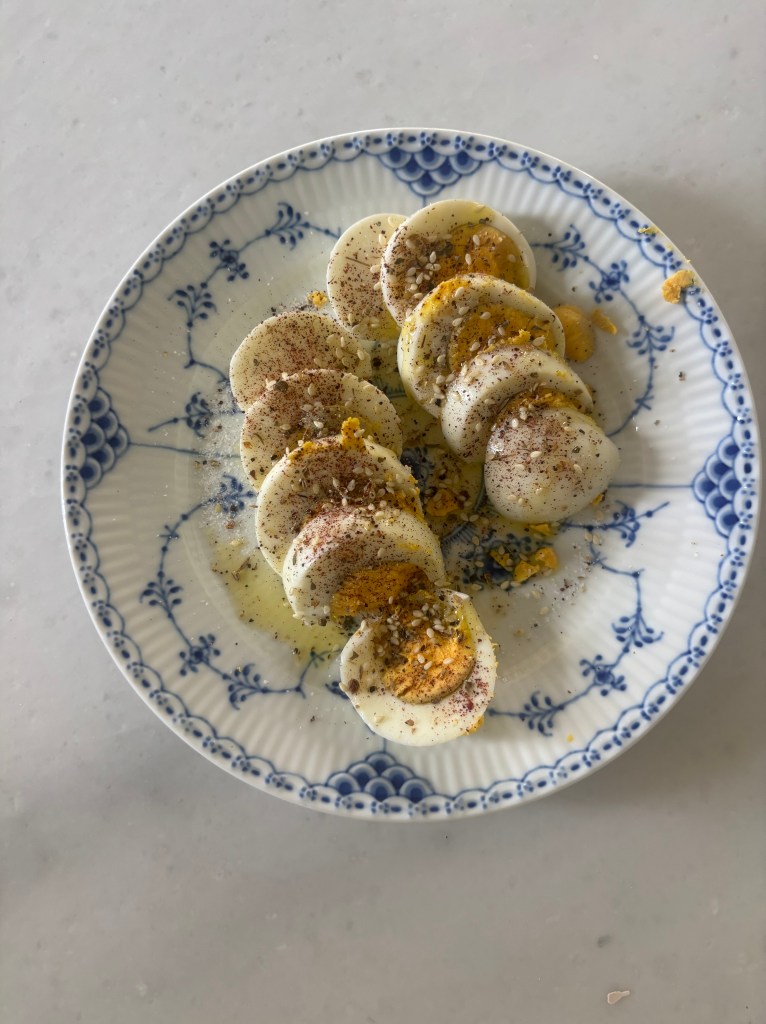
Notes: Home from California. Hard-boiled eggs in the fridge.
The eggs, the song, the poem: each seems simple.
Then it sneaks up on you. The deliciousness.
If Mary Ruefle’s mind were an egg, it would be Organic Pasture-Raised Grade A Large. Here she is in Madness, Rack, and Honey on art:
Isn’t all art irreverent? It is irreverent to create that which doesn’t exist; the newly made thing flies in the face of the already created and as such is based on negation (what already exits simply isn’t enough!), but born also out of the greatest reverence for what already is. When Borges, visiting the Sahara, picked up a little bit of sand, carried it in his hand and let it fall someplace else, he said, “I am modifying the Sahara,” and he wrote that this was one of the most significant memories of his stay. What Borges did is what we do when we write poems after millennia of poem writing. We aren’t saving the Sahara, we are modifying it, and you have to be irreverent to think you can modify the Sahara in the first place, and sincere in your attempt to do so.



Leave a Reply