I found the stairs somewhat more difficult than I had expected and so I sat down, so to speak, in the middle of the journey. Because there was a large window opposite the railing, I was able to entertain myself with the little dramas and comedies of the street outside, though no one I knew passed by, no one, certainly, who could have assisted me. Nor were the stairs themselves in use, as far as I could see. You must get up, my lad, I told myself. Since this seemed suddenly impossible, I did the next best thing: I prepared to sleep, my head and arms on the stair above, my body crouched below. Sometime after this, a little girl appeared at the top of the staircase, holding the hand of an elderly woman. Grandmother, cried the little girl, there is a dead man on the staircase! We must let him sleep, said the grandmother. We must walk quietly by. He is at that point in life at which neither returning to the beginning nor advancing to the end seems bearable; therefore, he has decided to stop, here, in the midst of things, though this makes him an obstacle to others, such as ourselves. But we must not give up hope; in my own life, she continued, there was such a time, though that was long ago. And here, she let her granddaughter walk in front of her so they could pass me without disturbing me.
I would have liked to hear the whole of her story, since she seemed, as she passed by, a vigorous woman, ready to take pleasure in life, and at the same time forthright, without illusions. But soon their voices faded into whispers, or they were far away. Will we see him when we return, the child murmured. He will be long gone by then, said her grandmother, he will have finished climbing up or down, as the case may be. Then I will say goodbye now, said the little girl. And she knelt below me, chanting a prayer I recognized as the Hebrew prayer for the dead. Sir, she whispered, my grandmother tells me you are not dead, but I thought perhaps this would soothe you in your terrors, and I will not be here to sing it at the right time.
When you hear this again, she said, perhaps the words will be less intimidating, if you remember how you first heard them, in the voice of a little girl.
from Faithful and Virtuous Night
Notes: "He is at that point in life at which neither returning to the beginning nor advancing to the end seems bearable; therefore, he has decided to stop, here, in the midst of things, though this makes him an obstacle to others, such as ourselves." I love how the narration of ordinary takes on the resonance of allegory. It's in both the tone (the register shifts in a way that reminds me of Barthelme's "The School") and in the double focus: Glück both stays in the scene she has created and pans out toward something like universal wisdom. It takes gall to do what you're not supposed to do in poetry-- wax discursive on the Truth. But I think Glück pulls it off because the scene is weird enough to lock us into the moment, and because the wisdom of her seer-grandmother is equal parts true and mystical, wise as it is to the existential paralysis and particular species of depression that den in middle age (or whatever age we assign to what is in between very young and very old). What does Glück put her finger on? Through the voice of the grandmother, she knows how a person gets stuck on their climb. How he and everyone else gets there. Scared enough to stop on stairs. Or hide in crowds. Or file complaints. Or get swole and swear they'll live forever.
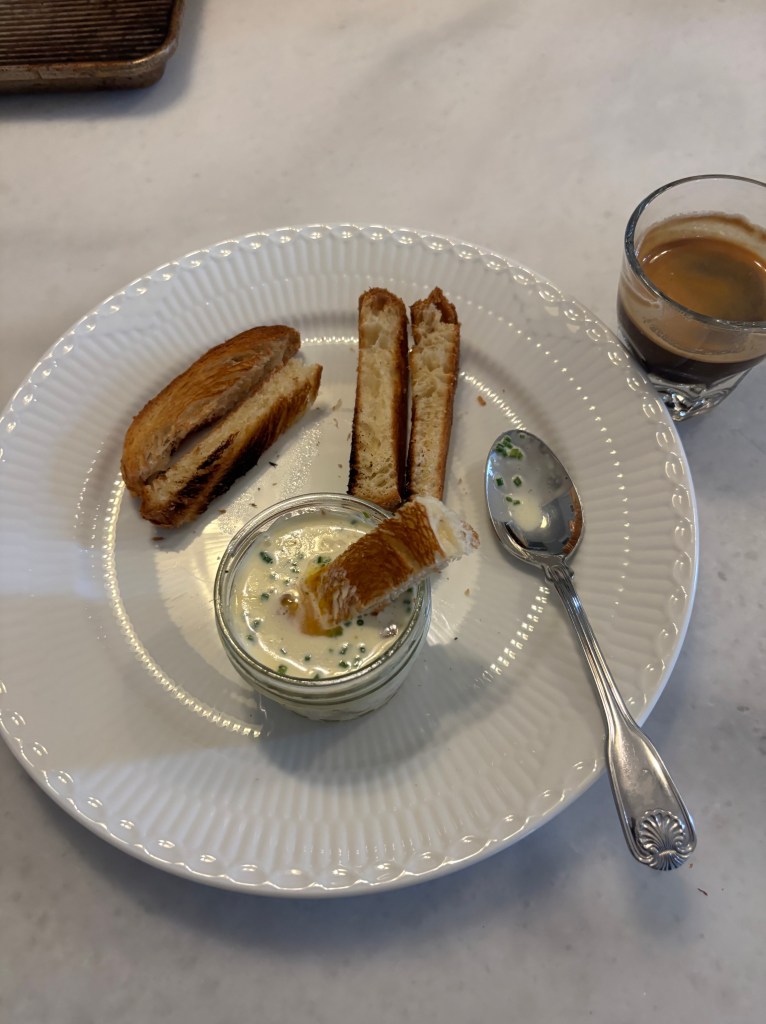
These eggs split the distance between workmanlike and luxe. Cook em in jar. An egg sandwiched in a little cream. Some fancy ingredients or not. Pull em from the bake before they get too defined...
The music - Glück and these eggs. Exhibits A and B as to how simple is a difficult thing. And for a creator, a maker, to present "simple" as a deliverable takes brass. Cream and eggs-- it all rides on texture, nowhere to hide. Getting the whites just to hold, the yolk molten. See how Glück rings wisdom into a what seems merely an inconsequential slab of a tale from the odd. Hell of a trick to pull that off. As Lucas sings, "It's so easy when you know what you're doing." I'm a fan of slow deliveries-- Lucas, Leonard Cohen, Bill Callahan-- where the lyrics are out in front, dangling, nowhere to hide. Where words and lines unfold slowly and are left naked in the light. And I love how, on this album, Lucas literally doubles down, double tracking himself singing with himself. It makes me feel both ways. Comforted. How lovely to hear the self sing with the self. And lonely. Because who are we singing for?



Leave a Reply