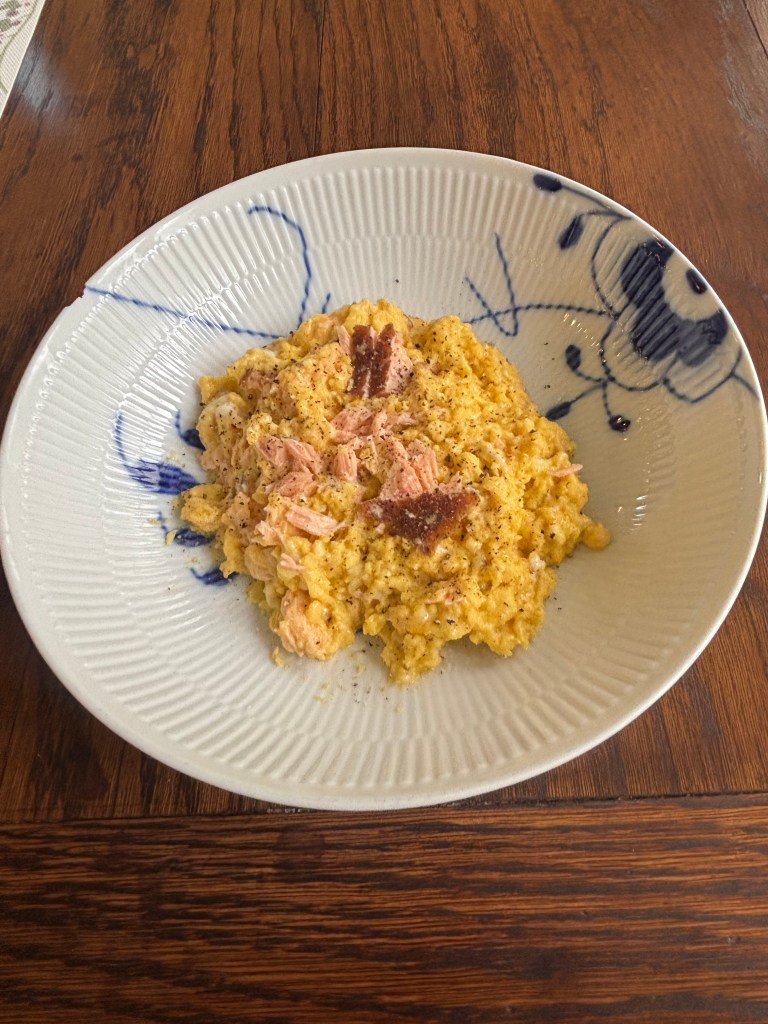
Eggs:Slow Scramble, French Style, with Hot-Smoked Salmon.
Music:"The Creator Has a Master Plan" by Pharaoh Sanders apple music spotify
Poem: "Letter of Testimony" by Octavio Paz (translated by Eliot Weinberger, The Poems of Octavio Paz). It's a lonnnnnnnnng poem. Best enjoyed somewhere you can settle with a strong cup of something. Or you can scroll past if you want to skip to the notes.
Letter of Testimony Cantata 1. Between night and day there is an uncertain territory. It is neither light nor shadow: it is time. The hour, the precarious pause, the darkening page, the page where I write, slowly, these words. The afternoon is an ember burning itself out. The day turns, dropping its leaves. A dark river files at the edges of things. Tranquil, persistent, it drags them along, I don't know where. Reality drifts off. I write: I talk to myself -- I talk to you.
I wanted to talk to you as the air and this small tree talk to each other, nearly erased by the shadows; like running water; a sleepwalking solilquoy; like a still puddle, reflector of instantaneous simulacra; like fire: with tongues of flame, a dance of sparks, tales of smoke. To talk to you with visible and tangible words, words with weight, flavor and smell, like things. While I speak, things imperceptibly shake loose from themselves, and escape toward other forms, other names. They leave me these words: with them I talk to you.
Words are bridges. And they are traps, jails, wells. I talk to you; you don't hear me. I don't talk with you: I talk with a word. That word is you, that word carries you from yourself to yourself. You, I, and fate created it. The woman that you are is the woman I talk to: these words are your mirror, you are yourself and the echo of your name. I, too, talking to you, turn into a whisper, air and words, a puff, a ghost that rises from these letters.
Words are bridges: the shadow of the hills of Meknès over a field of static sunflowers is a violet bay. It is three in the afternoon, you are nine years old and asleep in the cool arms of a pale mimosa. In love with geometry a hawk draws a circle. The soft copper of the mountains trembles on the horizon. The white cubes of a village in the dizzying cliffs. A column of smoke rises from the plain and slow scatters, air into the air, like the song of the muezzin that drills through the silence, ascends and flowers in another silence. Motionless sun, the enormous space of spread wings, over the flat stretches of reflections thirst raises transparent minarets. You are neither asleep nor awake: you float in a time without hours. A breeze barely stirs the distant lands of mint and fountains. Let yourself be carried by these words toward yourself.
2. Words are inexact and say inexact things. But saying this or that, they say us. Love is an equivocal word, like all words. It is not a word, said the Founder: it is a vision, base and crown of the ladder of contemplation --and the Florentine: it is an accident --and the other: it is no virtue but it is born of that which is perfection --and the others: a fever, an aching, a struggle, a fury, a stupor, a fancy. Desire invents it, mortifications and deprivations give it life, jealousy spurs it on, custom kills it. A gift, a sentence. Rage, holiness. It is a knot: life and death. A wound that is the rose of resurrection. It is a word: saying it, we say ourselves.
Love begins in the body --where does it end? If it is a ghost, it is made flesh in a body: if if is a body, if vanishes at a touch. Fatal mirror: the desired image disappears, you drown in your own reflections. A banquet for shades.
Apparition: the moment has eyes and a body, it watches me. In the end life has a face and a name. To love: to create a body from a soul, to create a soul from a body, to create a you from a presence. To love: to open the forbidden door, the passageway that takes us to the other side of time. The moment: the opposite of death, our fragile eternity.
To love is to lose oneself in time, to be a mirror among mirrors. It is no idolatry: to deify a creature and to call eternal that which is worldly. All of the forms of flesh are daughters of time, travesties. Time is evil, the moment is the Fall; to love is to hurl down: interminably falling, the couples we is our abyss. The caress: hieroglyph of destruction. Lust: the mask of death.
To love: a permutation, barely an instant in the history of primogenial cells and their innumerable divisions. Axis of the rotation of the generations.
Invention, transfiguration: the girl turns into a fountain, her hair becomes a constellation, a woman asleep, an island. Blood: music in the branches of the veins, touch: light in the night of the bodies.
Transgression of nature's fatality, hinge that links freedom and fate, question engraved on the forehead of desire: accident or predestination?
Memory, a scar: --from where were we ripped out? a scar, memory, the thirst for presence, an attachment to the lost half. The One is the prisoner of itself, it is, it only is, it has no memory, it has no scars: to love is two, always two, the embrace and the struggle, two is the longing to be one, and be the other, male or female, two knows no rest, it is never complete, it whirls around its own shadow, searching for what we lost at birth, the scar opens: fountains of visions, two: arch over the void, bridge of vertigoes, two: mirror of mutations.
3. Love, timeless island, island surrounded by time, clarity besieged by night. To fall is to return, to fall is to rise.
To live is to have eyes in one's fingertips, to touch the knot tied by stillness and motion. The art of love --is it the art of dying? To love is to die and live again and die again: it is liveliness. I love you because I am as mortal as you are. Pleasure wounds, the wound flowers. In the garden of caresses I clipped the flower of blood to adorn your hair. The flower became a word. The word burns in my memory.
Love: reconciliation with the Great All and with the others, the small endless all. To return to the day of origin. To the day that is today.
The afternoon founders. Street lamps and headlights drill through the night. I write: I talk to you: I talk to me. With words of water, fire, air, and earth, we invent the garden of glances. Miranda and Ferdinand gaze forever into each other's eyes until they turn to stone. A way of dying like others. High above the constellations always write the same word; we, here below, write our mortal names. The couple is a couple because it has no Eden. We are exiles from the Garden, we are condemned to invent it, to nurture our delirious flowers, living jewels we clip to adorn a throat. We are condemned to leave the Garden behind: before us is the world.
CODA Perhaps to love is to learn to walk through this world. To learn to be silent like the oak and the linden of the fable. To learn to see. Your glance scatters seeds. It planted a tree. I talk because you shake its leaves.
Notes: I was aiming for a long slow scramble of these eggs, intending to execute the classic French mode for a scramble. To do that, I should have used a double boiler, but I went for low heat on the burner, and they came together more quickly than I had planned. Silky, but not as crême de luxe as I wanted. To go with the slow cook, I put on Pharaoh Sanders half-hour "The Creator Has A Master Plan" which ended up being long enough to both cook and eat eggs by. And in keeping with the theme of long-form works, I've posted one of Octavio Paz's long poems, "Letter of Testimony."
In the song, the mantra boxes itself in: The creator has a working plan / peace and happiness for every man / The creator has a master plan / peace and happiness for every man / The creator has but one demand / peace and happiness through all the land. Then it dissolves into a bunch of "yeahs." Then it further unravels into some yodeling ululations, and then the lyrics stop and surrender to the music. I'm interested by a few things. First, the way the rather inane mantra picks up resonance by repetition. If there were a bunch of verses and "peace and happiness" bit were the chorus, I'd be disappointed. But here, it's like there's nothing else to say, even though these words don't suffice. They hit a wall, they hit their limit, and then it's just human voice, and then that stops and it's music. And the music too moves from melody and groove to something wilder and rawer. It makes me think about Deleuze & Guattari -- there is the body (with its rules and structures) and then there is the body without the organs that govern it. There is the unfolding of what has been ruled into what it might be if it were born into and lived in a world without rules. Here, Sanders & co take the organs out of the body (and eventually put them back in). And I think the music accomplishes what the words cannot. Sanders is aiming for the cosmic, the mystical, the transcendent, and he trusts the music more than the words to take us there.
I picked this Paz poem not just because I love Paz, but also because I think his poem is exploring similar territory to Sanders. The poem keeps hitting the dead end of words: "I talk to you." "I write." I feel the failure of words to do what the speaker wants them to do. The words don't bridge, they don't open, they don't carry, they don't pierce or translate or sing. At least not enough. As in the Sanders song, they hit the wall and realize their own impotence. But Paz, unlike Sanders, doesn't give up and turn to music, he keeps writing more words. And the words keep turning like a kaleidoscope through images and reconfigurations of the same images. Along the way, I think, like Sanders' music freakout, Paz's words start to get there, start to transcend their failure.
Sanders is audacious in writing a half hour song opening out of a cosmic bumper sticker (and succeeds in getting me to actually contemplate his bumper sticker). Paz is audacious in a writing a series of "To love is to...." That seems like a syntactical construction fated to end in cliché, an anaphora any poetry instructor would put on the merde list of "never do this." But Paz does. And it works for me.



Leave a Reply