
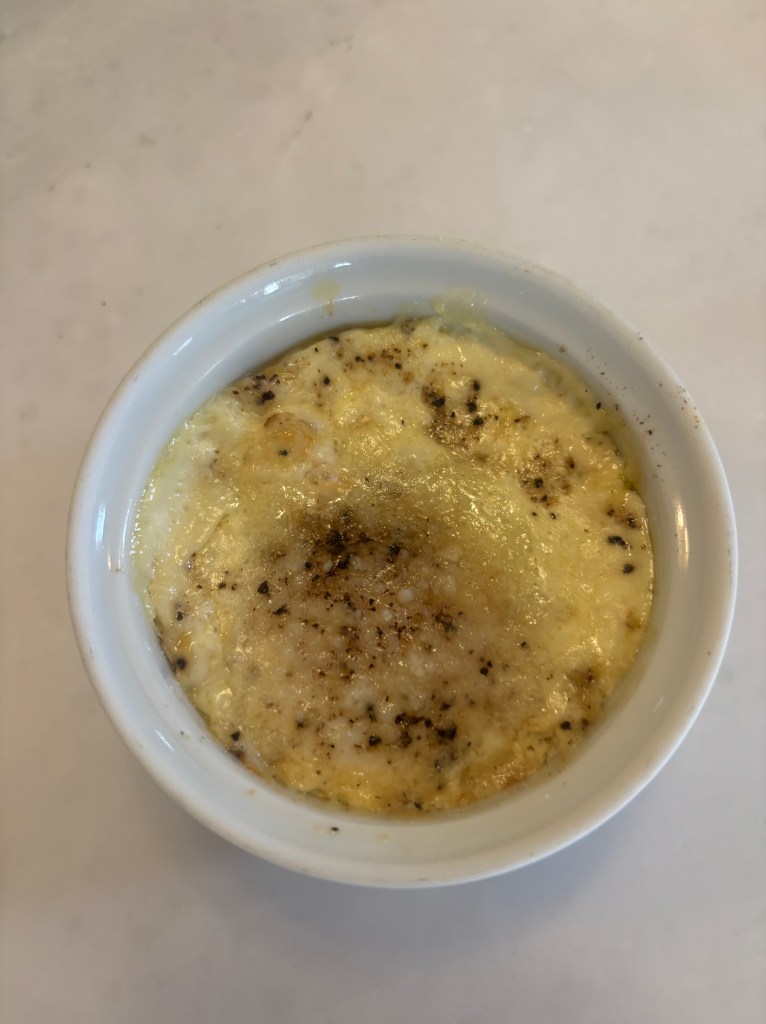
Eggs: Soft baked. Cream. Parmesan. Pepper
Song: “In Walked Bud” by Thelonious Monk (from Genius of Modern Music, Vol 1.)
apple music spotify
Poem: “Piano Lesson” by Richard Siken (from I Do Know Some Things)
Piano Lesson
When I was ten, I had an imaginary friend. He lived on pork and
beans and played the viola. People would look at us and hear sad
music, turn away. That’s pretty much how it was, what it was like,
for most of 1977. A viola is slightly larger than a violin. It makes a
deeper sound. The cello and the double bass: larger and deeper still.
All, like, Pinocchio, have hollow wooden bodies, thought Pinocchio
has more strings and is hollow only metaphorically. Guitars have
strings. Harps also. If a harp lay down and fell asleep and you
bludgeoned its dreams with felted hammers then you would have a
piano. If you were wearing a tuxedo, you would have a grand piano.
If you knocked a clock to the floor and left it there, on its back,
staring at the ceiling, spinning slowly to its own sad music, then
you would have a record player. Or a carousel, if you had horses,
or luggage. A table turns into a barricade, a vase into a broken vase.
The lazy Susan becomes the place where the lazy Susan used to be.
Pinocchio wants to be a real boy. The real boy wants to be a robot.
The dream of becoming. By 1699, although there were no pianos,
some composers were already anticipating their arrival. Sheet
music from the time shows notes too high or low to play on the
harpsichord. By 1837, with some refinement of the pedals, a player
could sustain the notes even after their hands had moved away. By
the time I was eleven I sopped being sad and started to be afraid.
Notes: If I took piano lessons, I’d ask my teacher to help me learn “In Walked Bud.” I remember hearing this song for the first time working at garden nursery center in high school. A college kid I worked with had it on tape and we listened to it as he drove a truck full of mum cuttings. Jazz was not a thing I knew. Thelonious was an excellent place to start.
In one of Siken’s other prose poems in I Do Know Some Things, he describes his sensibility as “metamodernist,” a term I had to look up. I’m on board. Like everyone else I know who did college in the 90s, I’ve run dry on postmodernism. Then there are those unhelpful, unlovely terms for where the world went next: post-truth, post-postmodernism, both of which are about as appealing as nihilism. Here’s Siken, in an interview Mandana Chaffa in the Chicago Review of Books explaining how he intends the term:
“[metamodernism is] characterized by an oscillation between seemingly opposing forces like enthusiasm and irony, sincerity and self-awareness. It’s not so much a tactic as a paradigm. Meaning can be both staged and honest. In some sense, meaning is staged on a foundational level. All language is staged; all sentences are speech acts. Similarly, all actions—even walking—are choreographed to some extent. Practice and intentionality are needed. . . the authentic self and the constructed self can exist simultaneously. What’s the distinction between expressing and performing? What’s the distinction between hope and prayer?”
Wikipedia has a nifty little swinging pendulum that captures how metamodernism continually oscillates “from the sincere seriousness of modernism to the ironic playfulness of postmodernism.” Earnest/Hopeful/Sincere —–> Playful/Cynical/Ironic.
This strikes me as right for art in 2026. On guard against naïveté, but burnt out on cynicism. By turns playful and serious. By turns, earnest and ironic.


Leave a comment